
The Russian invasion of Ukraine has recently begun its fifth year. As a major war involving a nuclear-armed Russia and a Ukraine that is supported by nuclear-armed NATO countries, this is one of the most significant episodes in the history of nuclear war risk. As such, it is worth taking stock to see where things stand.
First, a brief recap of the first four years. The war began in February 2022. At the start, conditions were changing rapidly, creating high concern about potential escalation to nuclear war; see GCRI’s official statement. Another moment of heightened concern came in fall 2022: in the Kharkiv counteroffensive, Ukraine rapidly regained extensive territory, raising concerns that Russia’s conventional military might collapse and it would resort to a nuclear attack to avoid defeat; see GCRI’s media activity on the risk.
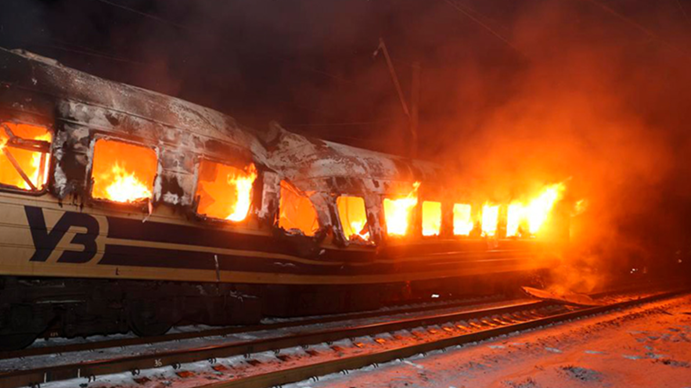
Since 2023, attention to nuclear war has been much more limited. The conflict settled into a war of attrition, which has been horrible for the combatants and citizens of both countries, especially Ukraine, such as the January 2026 passenger train attack shown above. However, the war of attrition has been relatively stable, which has made nuclear escalation considerably less likely—that is my own assessment, and I expect other analysts would readily agree. When I published a Ukraine-nuclear war scenario analysis in April 2025, I was among the only analysts still addressing the topic, and that remains true now.
Persistent Inattention
At present, the risk of nuclear escalation does get some attention. For example, it gets a few brief mentions in a scenario analysis published by Ukrainian experts, more on which below. But it’s clearly not a significant point of discussion the way it was in 2022.
What should we make of this inattention? It could mean that the current nuclear war risk is genuinely low—if it was high, people would be talking about it, just as they did in 2022. As long as the war remains in a stable attrition phase, this may be reasonable. However, more ominously, it could indicate a systematic neglect. Perhaps the risk is high, and through our inattention, we may end up caught off guard. The quantity of attention a risk receives is not always a reliable indicator of how large of a risk it is, including for global catastrophic risks.
Unfortunately, the possibility of systematic neglect does fit with certain worrisome tendencies of international security experts. As recent research documents, many experts predicted that Russia would not invade Ukraine, despite its military buildup along Ukraine’s border during winter 2021-2022. The research finds that analysts often made the mistake of assuming Russia wouldn’t do it because of the enormous costs an invasion would impose on Russia. One could apply the same tenuous reasoning to the belief that Russia wouldn’t initiate nuclear war.
Similarly, another recent study found that NATO national security officials are systematically overconfident. In discussing this research, nuclear security expert Christopher Chyba states, “Anyone with experience in interagency meetings in Washington has seen the social power of confident statements made with apparent certainty at the conference table—and the bureaucratic weakness of admitting to uncertainty. This is a broad cultural failing.”
Finally, it is important to note that Russia has a personalist regime, with major decisions made mainly by a single individual, Putin. Personalist regimes are notoriously difficult to predict because their behavior depends so heavily on the decision-making of a single individual, which can be idiosyncratic. This is a significant concern for nuclear war risk. Unless we can predict what Putin will do—and in general I don’t think we can—we cannot rule out the possibility of nuclear war.
That said, it is still the case that for now, the war remains in a relatively stable attrition phase. But what if we look ahead to the upcoming year?
Nuclear Escalation Risk in 2026
For most of the past two years, Russia has the upper hand on the battlefield, leveraging its larger population of troops to gain territory, though Ukraine has made gains over the past month. There is a nuclear war scenario in which Russia conquers all of Ukraine and pushes into NATO territory, creating a NATO-Russia war with potential for nuclear escalation. NATO takes the possibility of Russian invasion seriously: in 2023, NATO shifted its approach toward forward defense, in which they fortify select targets, such as the Baltics, against potential Russian invasion.
In practice, even prior to the past month, Russia’s gains within Ukraine were so slow that it did not project to come anywhere near conquering the entire country. It could conceivably start making faster gains if Ukraine’s economy collapsed, leaving Ukraine unequipped to maintain a successful defense. However, in December 2025, Europe made a $106 billion loan to Ukraine, which is supposed to cover Ukraine’s military needs for another year or two. This makes it very unlikely that Russia would push past Ukraine and into NATO for the foreseeable future.
Alternatively, Russia could invade NATO territory without having conquered all of Ukraine. An obvious aim would be to disrupt the NATO alliance: if Russia takes even a small bit of NATO territory, but NATO does not unanimously respond, it may signal the end of the alliance. Russia could do this without conquering Ukraine. Russia may be especially like to try this during a moment of internal NATO disunity, such as if the US actually carries through on its threats to invade Greenland. However, a Russian invasion of NATO would be a significant gamble. If NATO did actually respond vigorously, the result would again be a NATO-Russia war with potential for nuclear escalation [1].
Another nuclear escalation risk lies not with Russia’s military success, but with its failure. Russia has conquered some Ukrainian territory, but only at immense cost, and it has arguably failed at other goals: aligning Ukraine’s government with Russia instead of with the West and restoring Russia’s great power status. It continues to deplete its military stockpiles and financial reserves. Some analysts project that Russia could face an acute economic crisis in 2026; others propose that this may not be enough to significantly affect Russia’s warfighting within the next few years, but it could at least have some political effect.
The pressure on Russia could rise even more if the US reverses course and resumes aggressive support for Ukraine and/or pushes back against Russia in other ways. Currently, the US is less supportive of Ukraine. However, US threats toward Greenland are indicative of a more erratic foreign policy, so it would be unwise to dismiss the possibility of an abrupt shift in its posture toward Russia. That could further put Russia in a difficult situation.
“A declining power is often more dangerous than a rising one. Facing an economic spiral and depleted conventional forces, Vladimir Putin is entering a window of maximum danger.” So write William Dixon and Maksym Beznosiuk in a recent RUSI commentary. Escalating the conflict would allow Russia to maintain at least the appearance of great power status. Dixon and Beznosiuk propose that Russia will do this with more aggressive hybrid warfare against NATO countries, such as acts of sabotage on European military supply chains headed for Ukraine or nuclear threats intended to pressure Ukraine’s allies to back down. Russia has already been doing some of this, and they could be doing more. But what if that’s not enough? At that point, a nuclear attack does seem plausible, or nuclear brinkmanship that leads to an attack, however likely or unlikely it may be.
A nuclear attack would be a massive gamble, coming with the risk of further escalation to an all-out war resulting in the total annihilation of Russia. However, as I discussed last year, this could be deemed a rational gamble by Putin if battlefield losses threaten his domestic grip on power. Currently, Putin’s domestic approval rating sits at 85%, and it has been high throughout the war. This makes the nuclear gamble less likely, unless conditions change. Could his approval rating be pushed downward by an economic crisis, perhaps combined with at least some battlefield losses? Could he feel his grip on power slipping? These are factors to keep an eye on.
The Ukrainian expert scenario analysis adds a novel scenario, in which wars break out in multiple locations around the world. They posit that in this scenario, nuclear incidents in other regions could create the opportunity for Russia to use nuclear weapons in Ukraine to gain battlefield advantage. Remarkably, they rate this quasi-world war scenario (with or without nuclear escalation) as having a 20% probability. While I prefer not to attach numbers to these deeply uncertain matters, I want to say that this is much too high of a probability. However, I may be overconfident in thinking that way. Indeed, with recent recent US threats toward Greenland and attacks on Venezuela and Iran, perhaps this scenario is not so unlikely after all.
Taking all of this into account, in my estimation, the primary concern is the prospect of Russia, and especially Putin, feeling a sense of desperation and the need to gamble on risky escalation. This could happen even if Russia does not suffer major battlefield losses, but it would be especially likely if major losses occur. There are also important wildcard scenarios, such as if the US carries through with an invasion of Greenland or reverses its current course to become much more aggressive toward Russia. Efforts to manage the risk of nuclear escalation should proceed accordingly.
Risk Management
Last year, I recommended (1) taking the risk of nuclear escalation seriously, (2) providing gradually increasing support for Ukraine to balance between supporting them and avoiding nuclear escalation, (3) clear communication from NATO to avoid Russia miscalculating in any aggression on NATO territory, (4) appeal to the broader international community, especially China and India, to pressure Russia to not use nuclear weapons, (5) prepare to “responsibly” manage nuclear war so that, in the event that nuclear weapons are used, large-scale nuclear war is avoided, and (6) work toward the long-term goal of improved relations between Russia and the West.
This year, all of these recommendations remain relevant. With an eye toward a potential Russian sense of desperation, recommendations (4) and (6) seem especially pertinent.
***
[1] I previously addressed this scenario in a video on my personal (non-GCRI) channel here, as part of a broader discussion on the implications of a US invasion of Greenland on the risk of nuclear war.
Image credit: National Police of Ukraine, showing the 27 January 2026 Russian drone strike on a passenger train in northeast Ukraine.


.jpg)