Part of the GCRI Series on Democracy and Global Catastrophic Risk.
“It is easier to imagine the end of the world than the end of capitalism.” [1]
In political history, an order can be defined as a period of time in which one ideology is so dominant, it must be followed by any party in order for the party to gain power. Political orders heavily structure what policies are and are not possible, and are therefore very important for any policy issue, including global catastrophic risk. It is always worthwhile to understand political orders, but now it is especially important, because the political order is currently in flux and up for grabs, at least within the United States, and potentially also in other countries.
In this article, I’m going to tell the story of political orders in US political history and explain the significance for global catastrophic risk. This story intertwines with the stories told in recent articles on democratic participation and government procedure. Together, these three topics present three complementary perspectives on US political history, helping to make sense of how the country got where it is today and providing some guidance for global catastrophic risk policy initiatives and related activities.
Political Orders in US History
A political order is an inherently imprecise concept, and so there is no one singular way of describing their history in a particular country. For the US history, my primary reference is the recent book The Rise and Fall of the Neoliberal Order by Gary Gerstle, though my own interpretation is slightly different. The book covers the two most recent orders, and here I will do the same.
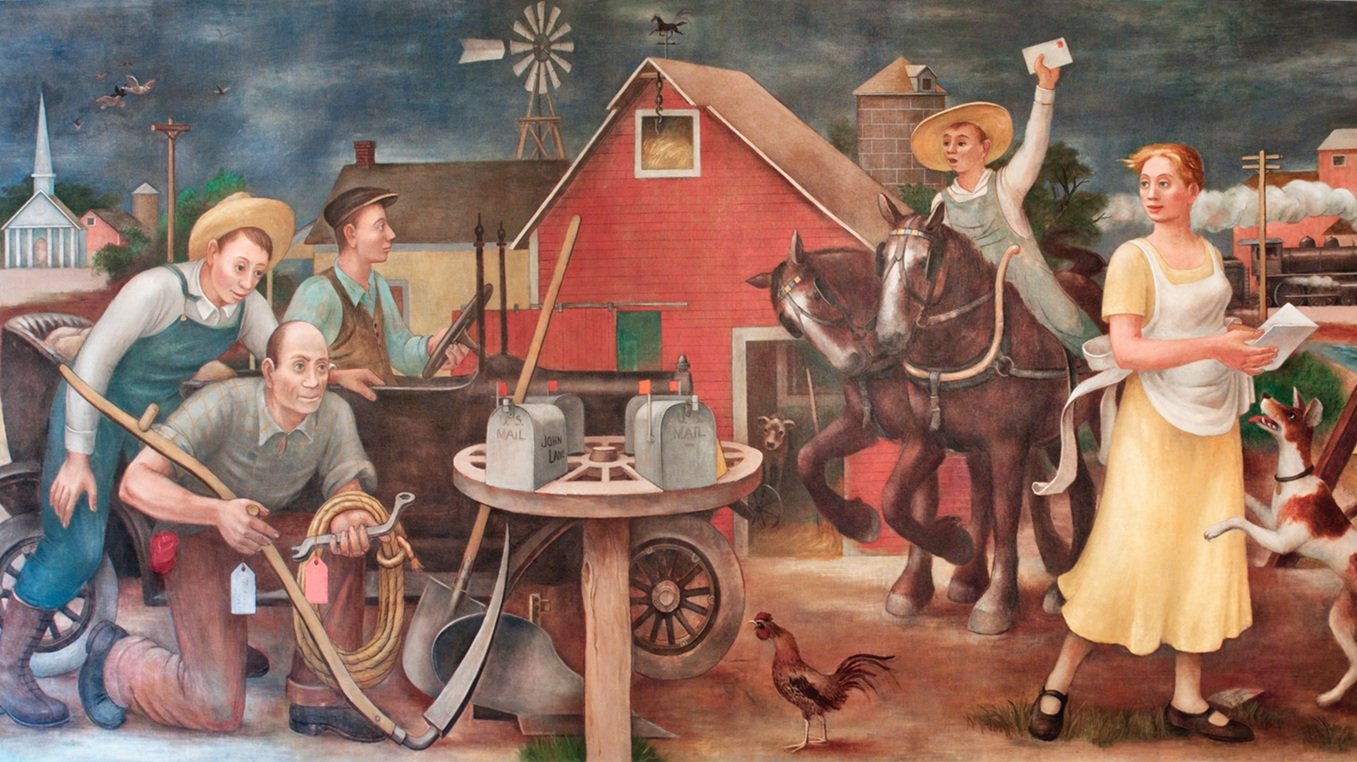
The second-most recent order was the New Deal. It began with the Presidency of Frank Delano Roosevelt in 1933 and continued until roughly the 1970s. The high point was arguably the Presidency of Dwight Eisenhower, 1953-1961. Whereas most New Deal politicians were Democrats, Eisenhower was a Republican who nonetheless embraced its principles, showing that this ideology had taken hold of both parties. The New Deal was characterized by a more active government role in the economy, pursuing both direct public projects and regulation of private industry, including the artwork shown above. Tax rates were relatively high, especially for those with high incomes, and inequality was relatively low.
The most recent order was neoliberalism. It unambiguously arrived with the Presidency of Ronald Reagan in 1981, but it can also be found in some elements of the Presidency of Jimmy Carter in 1977, such as airline deregulation. Its high point was arguably the Presidency of Bill Clinton, 1993-2001: most neoliberals had been Republican, whereas Clinton was a Democrat. Neoliberalism was characterized by a much more limited government role in the economy, focused largely on supporting capitalism and private businesses. Tax rates were lower and inequality grew substantially.
Four main factors caused the transition from the New Deal to neoliberalism. First, an anti-establishment New Left rejected the New Deal’s top-down institutions and homogeneous culture, which it derided as “the system”, in favor of a more individualistic counterculture. Their opposition to the Vietnam war was a major factor. Second, the growing civil rights movement fractured the New Deal’s political coalition, with white Southern segregationists switching to the Republican Party via its Southern strategy. Third, the 1970s US economy faced major challenges (stagflation) that New Deal policies struggled to handle, in particular rising competition from countries like Japan and Germany and oil supply disruptions from a newly assertive OPEC in response to conflicts in the Middle East, the latter worsened by car-centric US urban design. These conditions left the US public open to moving away from the New Deal. And so, the fourth factor: seizing the initiative was a well-organized community of neoliberal intellectuals (such as Milton Friedman), business leaders (such as the Coors and Koch families), and politicians (such as Reagan).
In this transition, one can see echoes of the transitions from more to less democratic participation and from more to less centralization of decision-making in government procedure. The 1960s and 1970s ushered in a more individualistic political culture: less participation in mass-membership political groups and civic activities, more local control in government decisions, and an economy more centered around unregulated private businesses. And so, the highly centralized, high-in-public-participation New Deal order transitioned to the more decentralized and private neoliberal order.
The neoliberal order started to fade in the mid-2010s with the growing prominence of politicians who rejected core neoliberal principles, such as Donald Trump’s embrace of tariffs and Bernie Sanders’s embrace of socialism. Despite them working within opposite political parties, both spoke to a widespread sense that the neoliberal order was not working out well for many people in the US, such as due to wealth inequality and certain economic activities moving abroad.
Currently, I would say that the US does not have a political order: there is no one singular ideology that both parties must follow to gain control. Instead, control has shifted back and forth between the parties and their (partially) diverging ideologies. My sense is that the next order is currently up for grabs. It seems like there’s a broad sense that what we currently have isn’t working. This is seen, for example, in the recent finding of statusquotastrophe sentiment, the apparently common view across the US population that status quo conditions are in some ways catastrophic. How the next order is defined, or if we even have one, could have extremely large implications for the country and the world, including for global catastrophic risk. Indeed, this may be among the most important things for the world.
I personally would advocate for a political order centered on a concept I will call “democratic welfarism”. It seeks to advance the general welfare of the population, as specified in the Preamble to the US Constitution, and to do so in a democratic, participatory manner. In my opinion, advancing the general welfare should be the primary aim of policy; other political concepts such as the New Deal or neoliberalism should only be embraced to the extent to which they advance the general welfare. Currently, welfarism is typically pursued only in less democratic manners, such as in the use of cost-benefit analysis (and risk analysis) in regulatory policy decisions and in the effective altruism community’s engagement in private philanthropy. To succeed politically, welfarism would need a more democratic character; this would also bring the more general benefits of democratic participation, such as better accountability to the public.
Implications for Global Catastrophic Risk
Neoliberalism has had major disadvantages for managing global catastrophic risk. At its core, neoliberalism favors private, individual action over public, collective action, but global catastrophic risk poses major collective action problems, in which individual self-interest goes against the collective group interest. Examples include greenhouse gas emissions, AI companies pursuing dangerous forms of advanced AI, and funding the research and development of vaccines for potential pandemic pathogens. The challenge is especially difficult because the benefits of reducing global catastrophic risk accrue to the entire world: even when a country governs itself collectively, there remains a collective action problem across countries. But having robust collective action within a country is at least a good starting point.
Another issue with neoliberalism is its orientation toward “lean” global supply chains. The use of “just in time” inventory management that delivers supply chain components just as they are needed to minimize the costs associated with inventory warehousing. This can reduce costs when everything is working well, but it creates a systemic risk in which small supply chain disruptions can cause large failures of economic systems. The extensive use of global supply chains, facilitated by neoliberal free trade agreements, has in many instances improved economic performance around the world, but it comes with downsides, one of which is a further weakening global resilience that increases global catastrophic risk.
In my opinion, whatever comes next, be it a return of something like the New Deal, a democratic welfarism as I have proposed, or something else, should include robust action to reduce global catastrophic risk alongside measures to improve living conditions across the population. Statusquotastrophe should be ended. There is so much going wrong in the US right now, but also so much potential to make things better.
[1] This quote is attributed to both Fredric Jameson and Slavoj Žižek in the book Capitalist Realism: Is There No Alternative? by Mark Fisher.
Image credit: Country Post mural by Doris Lee at the Ariel Rios Federal Building, part of the New Deal Federal Art Project, Section of Painting and Sculpture, photographed by Carol M. Highsmith.