
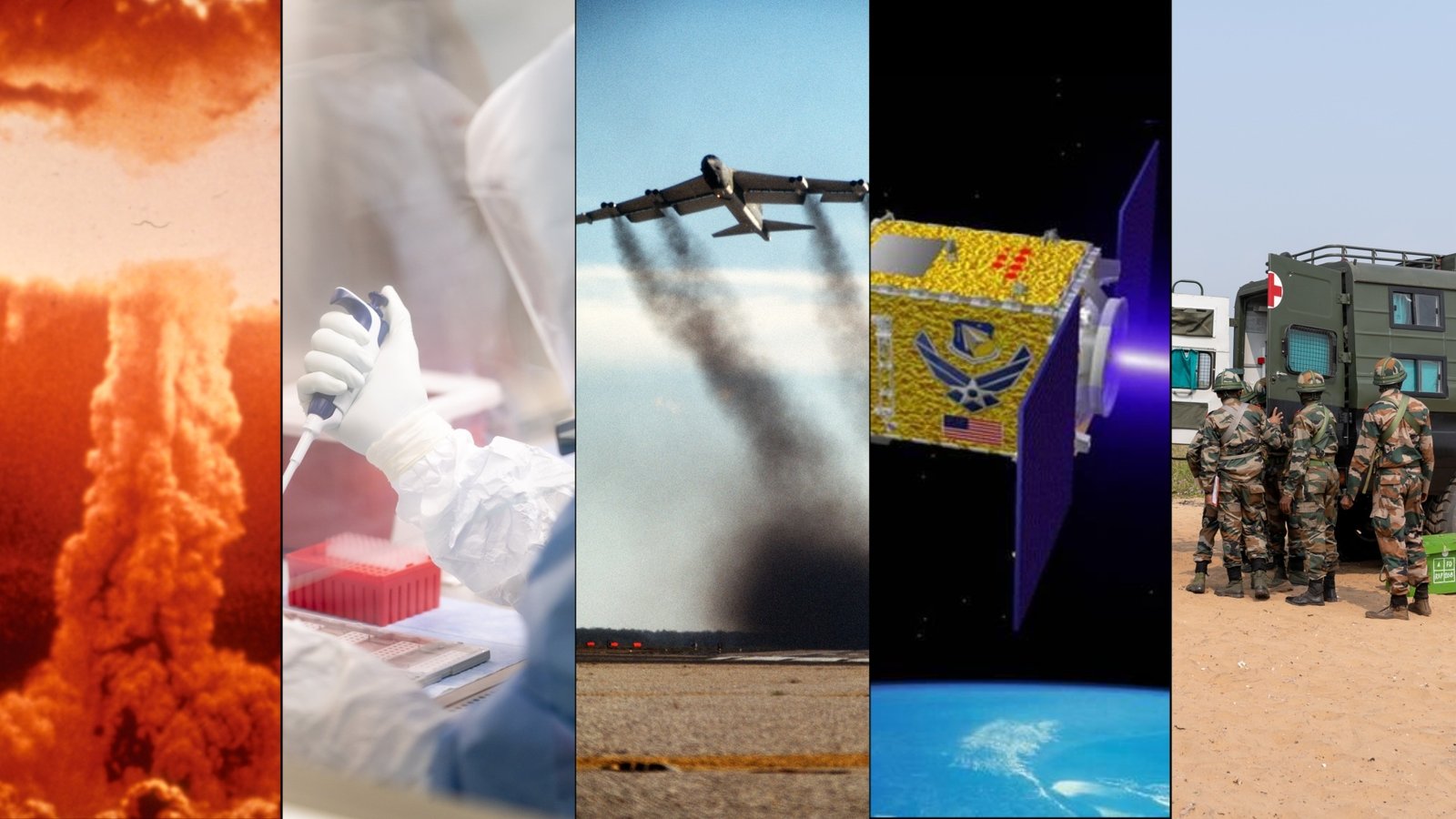
How do militaries affect global catastrophic risk? The stakes here are quite large. Militaries are among the largest and most impactful institutions in the world, and they are charged with the use of large-scale violent force. This report, authored by a team of global catastrophic risk experts with extensive backgrounds in military affairs and international security, surveys the full range of effects that militaries can have on global catastrophic risk. The report finds a complex relationship between militaries and global catastrophic risk, including numerous ways in which militaries can both increase and decrease the risk.
The report is led by Zachary Kallenborn, a Ph.D. candidate in Risk Analysis at King’s College London, and includes co-authors John Fogle, an independent researcher formerly at the US Air Force, Seth Baum, the Executive Director of GCRI, Gary Ackerman, a security expert and Associate Professor at SUNY Albany, and Kyle Kilian, an analyst at RAND and formerly at the US Department of Defense. The report is mainly focused on the US military due to the authors’ expertise, but many of the details also apply to the militaries of other countries.
The report identifies five major categories for the ways in which militaries can affect global catastrophic risk:
• Acts of violence: wars, counterterrorism, and other activities that inflict harm on opponents.
• Technology research and development: support for or other involvement in the process of studying and developing new offensive and defensive technologies.
• Environmental impacts: environmental protection and activities that may harm the environment, whether intentional or inadvertent.
• Outer space: any activity involving outer space, whether to project force or for other purposes.
• Catastrophe management: preparation for, response to, and recovery from a catastrophic incident.
The report surveys each of these five categories. From its survey, the report finds several cross-cutting themes:
• Militaries touch many aspects of GCR, including important impacts on aspects that might not traditionally be considered the domain of the military, such as climate change.
• Great power militaries like those of the United States, Russia, and China are likely to have disproportionately large effects (positive and negative) on GCR compared to smaller militaries.
• Militaries can function as both drivers of GCR (causing an increase in the risk) and mitigators (causing a decrease in the risk).
• The effect of militaries on GCR will vary, sometimes extensively, across different global catastrophe scenarios. For example, militaries may be a key driver in nuclear war scenarios and a key mitigator in societal collapse scenarios.
• Militaries are not independent actors, but instead are embedded in global societies, and likewise, their decisions and actions shape and are shaped by larger systemic contexts.
The report makes a distinctive contribution to the study of global catastrophic risk as the first cross-risk study of how a major type of institution affects the multitude of global catastrophic risks. An institution-centric study of global catastrophic risk is important because institutions have large impacts on the risk and because institutions are a primary focus of policy-making and professional activity, as demonstrated by the authors’ professional backgrounds. A cross-risk study of institutions provides guidance for how people who work in that type of institution can account for global catastrophic risk in their work. Indeed, a primary goal of this study is to support people in military affairs who may wish to help reduce the risk of global catastrophe.
Academic citation:
Zachary Kallenborn, John M. Fogle, Seth D. Baum, Gary A. Ackerman, and Kyle A. Kilian, 2026. The complex relationship between militaries and global catastrophic risk. Global Catastrophic Risk Institute Technical Report 26-1.
Image credits:
Nuclear explosion: US Federal Emergency Management Agency
Biolab: US Department of Homeland Security
Airplane: US Air Force
Satellite: US Air Force
Humanitarian response: US Marine Corps




_tour_of_the_National_Biodefense_Analysis_and_Countermeasures_Cetner_(NBACC)_at_Fort_Detrick,_Maryland_on_June_16,_2025_26.jpg)


