A few months ago, one of us (Seth Baum) published an article posing the following question:
Is progress on contrails avoidance limited more by the ability to avoid contrails or the motivation to actually do it?
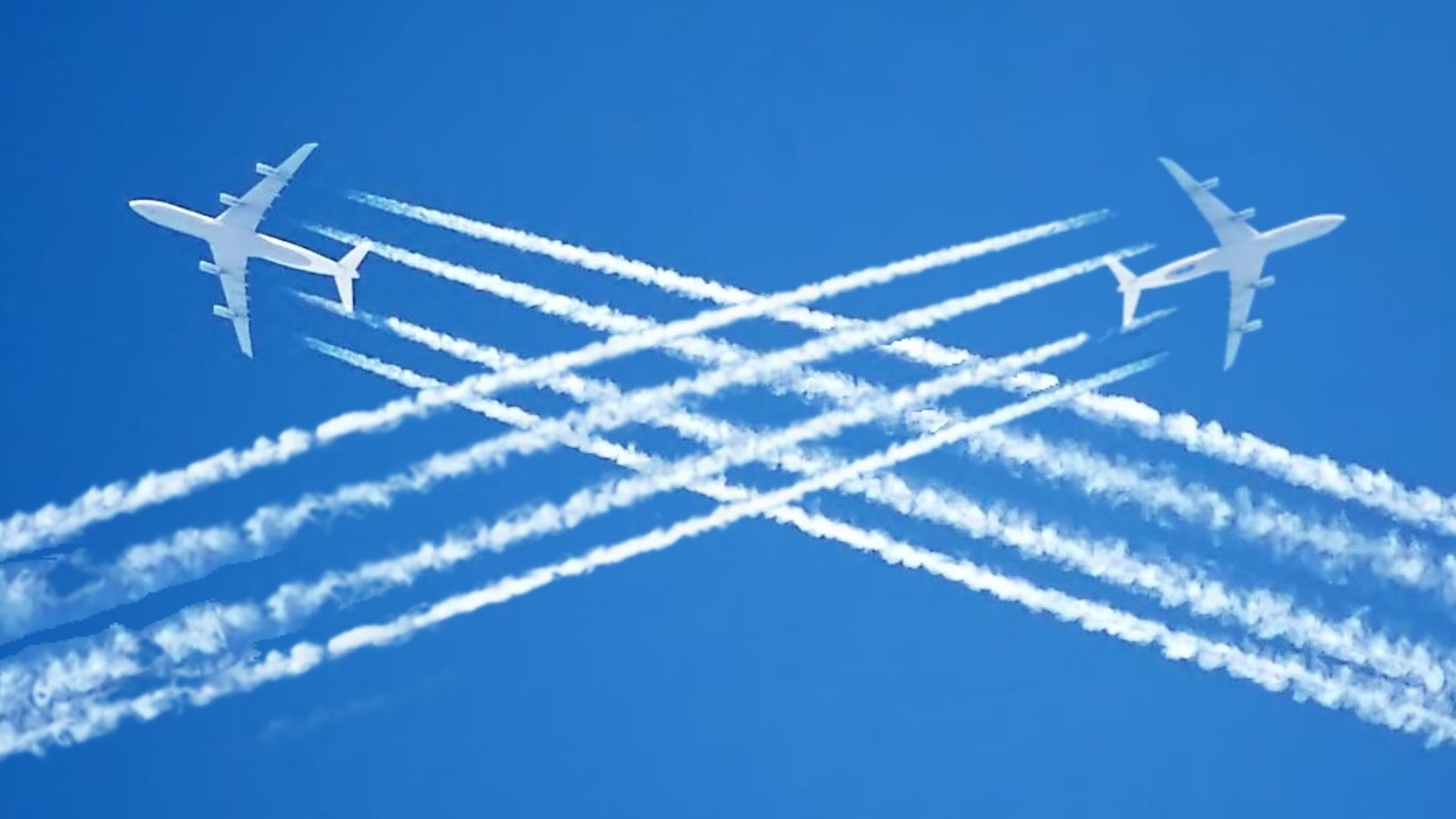
As the article explains, contrails are ice clouds caused by aircraft emissions of water vapor and soot particles at high altitude. Most contrails are short-lived and have little climate effect, but some persist and spread into contrail cirrus, whose ice crystals can contribute to global warming by trapping more outgoing radiation from the surface (i.e., the greenhouse effect) than they reflect away incoming radiation from the sun. It may be possible to avoid contrail formation by shifting airplane flight paths. Thus far, the aviation sector has only conducted some limited test programs. So, Baum’s article asked: Is more research and testing needed to address scientific uncertainties and logistical challenges? Or is the capacity for contrail avoidance available, and the aviation sector just needs to be pushed to actually do it, such as via public pressure?
To answer this question, we reached out to eleven contrails experts. Seven responded sharing their views. This was an informal survey and our results are not definitive, but we nonetheless believe we have learned things worth sharing.
Our primary finding is that experts lack consensus on how to proceed on contrails, holding significant points of disagreement. Indeed, some even questioned whether contrail avoidance is a good goal to pursue in the first place.
The Contrails Debate
An important part of the debate is the contrails-CO2 tradeoff. Shifting airplane flight paths to avoid contrails may result in more fuel consumption and likewise higher CO2 emissions. Depending on how the tradeoff is resolved, this may result in a net worsening of climate change, which defeats the purpose of contrail avoidance. A complicating factor is that contrails last for only a few hours, whereas CO2 stays in the atmosphere for centuries or longer. So, the tradeoff includes an ethical judgment on the importance of shorter vs. longer changes in the greenhouse effect.
Another factor is scientific uncertainty. Specific points of uncertainty include the predictions of ice supersaturation for individual flights, the volatility of global radiative forcing estimates, the microphysics of ice crystals involved in contrails formation, and the relation between model results and real-world observations. This scientific uncertainty means that there may also be uncertainty about whether a particular airplane flight path shift results in a reduction in the contrails greenhouse effect, or if it results in enough of a reduction to outweigh an increase in CO2 emissions.
The more cautious experts think these reasons make it premature to implement large-scale contrail avoidance programs. They frame the issue of shifting airplane flight paths as an uncertain short-term climate benefit (possibly avoiding contrails) in exchange for a certainty of long-term climate harm (increased CO2 emissions). This means, in their view, that the uncertainty about contrails is quite high, making it difficult to assess the climate impacts of contrails avoidance, and they argue that it would therefore be irresponsible to implement large-scale contrail avoidance programs at this time. Instead, they call for basic research and limited, carefully designed trials to reduce the scientific uncertainty, pointing to recent publications such as this and this.
In contrast, the more aggressive experts argue that the scientific uncertainty and the contrails-CO2 tradeoff are both manageable and do not alter the conclusion that contrail avoidance can be a clear net climate benefit. They frame the issue in terms of the urgency of climate change and the need to take action even in the face of uncertainty. They argue that the main challenge at this time is not the scientific uncertainty but instead is the logistics of implementing contrail avoidance across the aviation sector. They therefore call for continued small-scale trial programs to test and improve operational capacity to avoid contrails, build evidence showing that it works, and establish industry standards as a prelude to sector-wide contrail avoidance. They point to recent publications such as this and this.
There was also disagreement among experts on the role of the public. Two experts argued that public pressure could help push the aviation industry to do more, echoing a view that had informed our prior work. In contrast, others warned against public outreach about contrails, but they gave different reasons. One of the more skeptical experts believed that pushing for public outreach at this point in time is not particularly useful since the science does not yet justify pushing for contrail avoidance, while another argued that too much public pressure could be counterproductive by making the industry more defensive and less cooperative. Multiple experts noted that, currently, the industry is at least somewhat cooperative in participating in trial programs without any public pressure. From that perspective, there may be more of a role for public pressure at a later point, after trial programs have run their course and when the focus shifts to potentially scaling up to industry-wide contrail avoidance.
Finally, the expert comments we received hinted at a possible underlying disagreement about conceptual paradigms for climate change solutions. Shifting airplane flight paths is a technological solution, in contrast with the social solution of reducing the number of airplane flights made in the first place. People with a paradigmatic belief in technological solutions may tend to favor a more aggressive stance on contrails avoidance. One of the more cautious experts expressed concern that contrails funders generally favor the technological paradigm, and that this may bias the entire conversation in favor of more aggressive contrails avoidance. However, this expert comment came late in our process, so we cannot say how much our experts hold divergent paradigms.
We note that there was no disagreement about the harmful role of aviation in climate change. All of our experts expressed deep concern about climate change and a genuine desire to see the aviation sector reduce its impact. The debate is entirely about how best to achieve that. Among the more aggressive experts, there was some concern that the cautious experts are giving industry an excuse for inaction. Whether or not that’s the case, it doesn’t mean the cautious experts actually support the aviation industry; indeed, one of them made a point of noting that he does not like the industry and hasn’t taken a personal plane flight in 25 years out of concern for the climate.
Our View
Much of the expert debate involves highly technical details about contrails research, such as questions of atmospheric physics, climate modeling, and ice microphysics that require specialist expertise to evaluate. Resolving these disputes is beyond what we are able to do here. Nonetheless, we can reach some conclusions about the broader landscape and what would be needed to move forward.
First and foremost, we believe continued work on contrails is worthwhile. Our expert conversations have shown us that the issue of contrails avoidance is more complicated than we anticipated, but nothing we’ve seen suggests that it should be abandoned. All of our experts argued that contrail formation is a serious issue worth engaging with; we agree.
Second, there is clear value for continued investment in basic research on contrails, including the environmental science as well as the social and ethical dimensions, such as the contrails-CO2 tradeoff. All of our experts agreed that there are scientific uncertainties; they only disagreed about how significant those uncertainties are and the implications for how to proceed. The only downside to contrails research is the cost of funding it, but in our opinion, this is a worthwhile expenditure, especially for government research agencies seeking to have a positive public impact. Importantly, the research can be pursued independently of airline trial programs, making it worthwhile from both cautious and aggressive perspectives on contrail avoidance.
Third, small-scale trial programs can be worthwhile, especially if they are designed to support learning and improved decision-making. The contrails-CO2 tradeoff is less significant for trial programs because they only shift the flight paths of a small number of flights. The knowledge and experience produced from a well-designed trial program is likely much more important than any small increase in CO2 emissions. The main increase in CO2 emissions would come from large-scale contrail avoidance programs, but small-scale trials do not necessarily make large-scale programs inevitable. We see no compelling reason to object to small-scale trials that are focused on learning more about contrail avoidance and improving the aviation sector’s ability to make sound decisions about large-scale programs.
Fourth, we encourage contrails experts with diverging views to engage in constructive dialog with each other to understand each others’ perspectives and work toward consensus. Finding common ground may seem challenging, such as due to divergent beliefs about contrails avoidance and paradigms for climate solutions. However, achieving consensus could make the contrails expert community more persuasive in its appeals to the aviation industry, policy makers, and other groups. From what we’ve seen, contrails experts all share a common commitment to addressing climate change through rigorous analysis and responsible behavior within the aviation sector; it’s just a question of what that means under the current circumstances. That’s a good starting point for dialog [2].
Some of the experts’ disagreement may hinge on scientific details that could potentially be resolved via more research or even just a closer read of the existing literature. Other parts of the disagreement may be more of an ethical character, such as how to resolve the contrails-CO2 tradeoff or how to handle decision-making under uncertainty about contrails and the urgency of climate change. To reconcile this aspect of the debate, it may help to bring in people with backgrounds in ethics, risk and decision analysis, and other relevant fields. Even if some of the disagreement is rooted in irreconcilable differences in moral values, it can help to clarify this and relate it to more general issues in moral philosophy and related domains.
Fifth, we urge funders and other supporters of work on contrails to account for the range of expert opinion. We appreciate that the urgency of climate change is a reason for an aggressive general approach to reducing greenhouse gas emissions. However, in the specific case of contrails avoidance, it is important to be mindful of the possibility of doing more harm than good.
Sixth, at this time, we would advise against pursuing public pressure campaigns on contrail avoidance. This idea had remarkably little support across our experts, with many viewing it as unnecessary or even counterproductive. In our view, the potential for it being counterproductive is nontrivial: it can involve taking an adversarial stance toward the aviation industry, which could make them less inclined to cooperate on contrails. As long as the industry is being generally cooperative, there just isn’t enough of a reason to pursue public pressure. There may be a role for public pressure in the future if circumstances change, but for now the potential downsides outweigh the benefits, and environmental organizations are better placed to focus their energy on areas where the value of public pressure is more clear-cut.
That said, we do see value in raising awareness of contrails within specialist environmental communities, where audiences can engage with the nuances of the debate. Currently, awareness remains very low, even within communities of environmental professionals. Indeed, both of us work on environmental issues, and yet neither of us knew about contrails until just a few months ago. We would encourage coverage of this debate within specialist environmental media outlets such as Canary, Carbon Brief, GreenAir News, Heatmap, and Volts. This would help reach people who could play significant roles in contrails research, industry outreach, policy development, and leading any future public pressure campaigns.
***
[1] Specific points of uncertainty mentioned include the inability to accurately predict ice supersaturation for individual flights, the volatility of global radiative forcing estimates, and the inability to verify model results with real-world observations.
[2] GCRI recently published a Symposium on World Peace that studied how to resolve disagreements among international rivals (e.g., China and Russia vs. the West) to reduce the risk of nuclear war and other global risks. Compared to this, resolving disagreements between contrails experts should be quite a lot easier.
Image credit: original photo by Adrian Pingstone Arpingstone, edits by Seth Baum