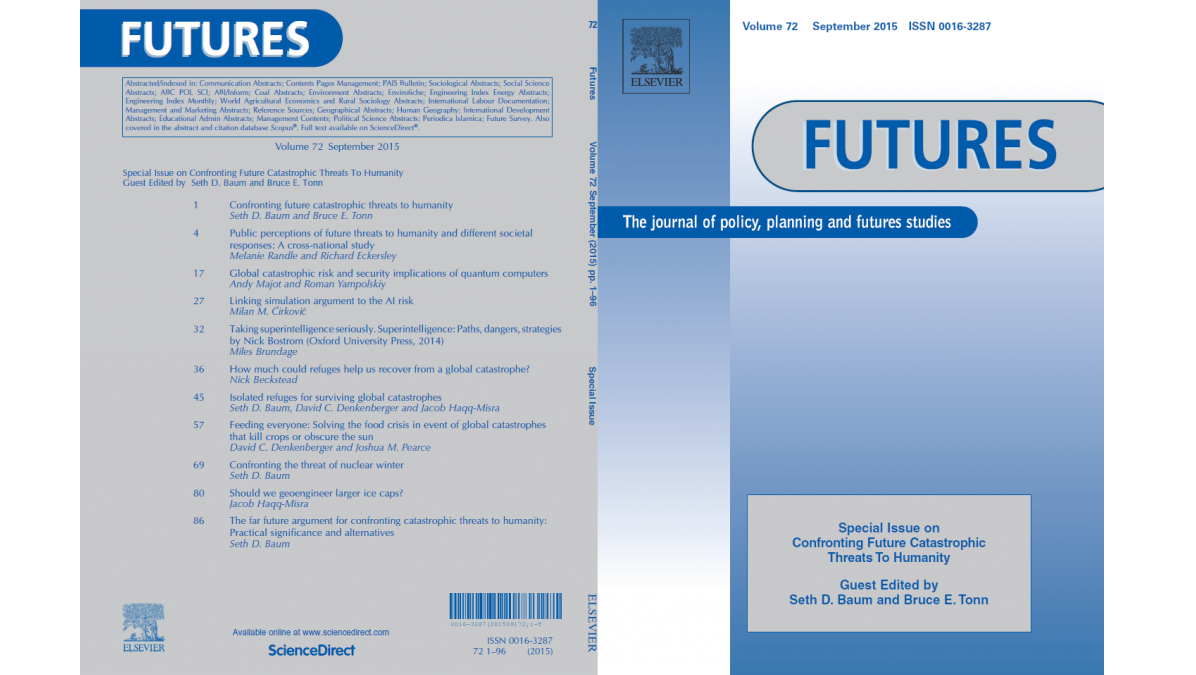
Confronting future catastrophic threats to humanity is a special issue of the journal Futures co-edited by Bruce Tonn and myself. It contains 11 original articles discussing a range of issues on catastrophic threats. It is part of ongoing attention to catastrophic threats in Futures.
Relative to prior collections, such as the 2008 book Global Catastrophic Risks and the 2009 special issue of Futures Human Extinction, this special issue aims to contribute more of a practical focus to the study of catastrophic threats to humanity, in order to better guide humanity’s efforts to confront the threats. The articles focus on how to reduce the probability or severity of such threats and related matters. There are many threats and ways to confront them, and so the articles cover a wide range of specific topics. This is not a comprehensive work on how to confront the threats—it is a compilation of innovative new research. The collection thus shows some of what experts on catastrophic threats are currently working on.
The articles in the collection are:
Seth D. Baum and Bruce E. Tonn, 2015. Introduction: Confronting future catastrophic threats to humanity. Futures, vol. 72 (September), pages 1-3.
Introductory editorial to a special issue of the journal Futures.
Melanie Randle and Richard Eckersley, 2015. Public perceptions of future threats to humanity and different societal responses: A cross-national study. Futures, vol. 72 (September), pages 4-16.
Citizens of Australia, Canada, the United Kingdom, and the United States hold significant concern for catastrophic threats to humanity.
Andy Majot and Roman Yampolskiy, 2015. Global catastrophic risk and security implications of quantum computers. Futures, vol. 72 (September), pages 17-26.
Quantum computing could thwart encryption, with catastrophic political and economic consequences.
Milan M. Cirkovic, 2015. Linking simulation argument to the AI risk. Futures, vol. 72 (September), pages 27-31.
The potential for global government to avoid AI catastrophe makes it less likely that humanity exists within a computer simulation.
Miles Brundage, 2015. Taking superintelligence seriously. Futures, vol. 72 (September), pages 32-35.
A review of the recent book Superintelligence by Nick Bostrom.
Nick Beckstead, 2015. How much could refuges help us recover from a global catastrophe?. Futures, vol. 72 (September), pages 36-44.
Refuges to help small populations survive global catastrophes may not be cost-effective relative to other options for reducing global catastrophic risk.
Seth D. Baum, David C. Denkenberger, and Jacob Haqq-Misra, 2015. Isolated refuges for surviving global catastrophes. Futures, vol. 72 (September), pages 45-56.
Refuges could help small populations survive global catastrophes if certain refuge design criteria are met.
David C. Denkenberger and Joshua M. Pearce, 2015. Feeding everyone: Solving the food crisis in event of global catastrophes that kill crops or obscure the sun. Futures, vol. 72 (September), pages 57-68.
If a catastrophe destroys global agriculture, it may be possible to feed humanity using foods grown from trees and other biomass or from fossil fuels.
Seth D. Baum, 2015. Confronting the threat of nuclear winter. Futures, vol. 72 (September), pages 69-79.
Many actions could reduce the probability or severity of the global environmental consequences of nuclear war.
Jacob Haqq-Misra, 2015. Should we geoengineer larger ice caps?.Futures, vol. 72 (September), pages 80-85.
With millennia of effort, humanity may be able to create larger ice caps, making the global climate cooler and more stable.
Seth D. Baum, 2015. The far future argument for confronting catastrophic threats to humanity: Practical significance and alternatives. Futures, vol. 72 (September), pages 86-96.
A lot can be done to prevent major global catastrophes without appealing to the benefits that would go to people living thousands, millions, or billions of years in the future.
Academic citation:
Seth D. Baum and Bruce E. Tonn (editors), 2015. Confronting future catastrophic threats to humanity [Special issue]. Futures, vol. 72 (September), pages 1-96.
Image credit: Elsevier
This blog post was published on 31 August 2020 as part of a website overhaul and backdated to reflect the time of the publication of the work referenced here.